


[Dry Goods] Detailed Explanation of Brazing Technology Principle Process and Common Defect Treatment Methods!
Release time:
2021-11-26
【Summary Description】 Welding expert Fu Jing, for you to detail the principle of brazing process and common defects of the treatment method!
The brazing deformation is small, the joint is smooth and beautiful, and it is suitable for welding between dissimilar materials, especially precision, complex and components composed of different materials, such as honeycomb structural plates, turbine blades, carbide tools and printed circuit boards.
regular brazing is the use of lower than the base metal melting temperature of the solder, take.Below the solidus of the base metal and above the brazing filler metalOperating temperature of the liquidus, The base metal is connected together by molten solder.
Fusion welding is a welding technique that is connected together by destroying the base material itself. Such as electric welding.
Compared with welding, the base metal does not melt during the brazing process, and only the brazing filler metal melts, which has little effect on the base metal.
Brazing process decomposition:
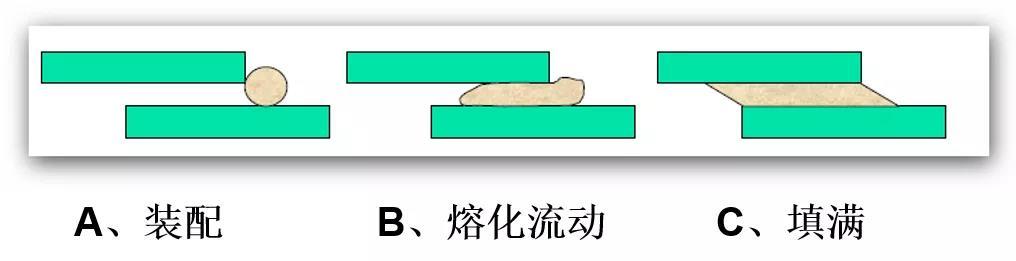
The workpieces with cleaned surfaces are assembled together in a lap pattern, and the brazing filler metal is placed near the joint gap or between the joint gaps, and the welding is completed through the following three processes:
One is the melting and caulking process of flux, that is, the preset flux flows into the gap of the base metal after heating and melting, and has physical and chemical effects with the oxide on the surface of the base metal to remove the oxide film, clean the surface of the base metal, and create conditions for the filling of the solder;
The second is the process of melting and filling the brazing seam, that is, as the heating temperature continues to rise, the brazing material begins to melt, wet and spread, and at the same time, the flux residue is eliminated;
The third is the interaction process between the solder and the base metal, that is, under the action of the molten solder, a small part of the base metal is dissolved in the solder (that is, the diffusion of the base metal to the liquid solder), and the solder diffuses into the base metal, and some complex chemical reactions occur at the solid-liquid interface.
When the solder fills the gap and heat preservation for a certain period of time, it begins to cool and solidify to form a brazed joint.The weld formed by brazing is called brazing seam, and the filler metal used is called brazing filler metal.

Brazing materials with diversified composition and morphology
There are many common processes for brazing, which are mainly distinguished by the equipment used and the working principle. For example, according to the heat source, there are infrared, electron beam, laser, plasma, glow discharge brazing, etc. According to the working process, there are contact reaction brazing and diffusion brazing.
Contact reaction brazing is to fill the joint gap by using the liquid phase generated by the reaction between the brazing filler metal and the base metal.
Diffusion brazing is to increase the insulation diffusion time, so that the weld and the base metal are fully uniform, so as to obtain the same performance of the base metal joint.

1. Soldering iron soldering
For soldering small simple or very thin parts.
2. Flame brazing
The flame of combustible gas mixed with oxygen or compressed air is used as the heat source for welding. The flame brazing equipment is simple and easy to operate. According to the shape of the workpiece, multiple flames can be used to heat and weld at the same time. This method is suitable for the welding of small and medium parts such as bicycle frames and aluminum kettle nozzles.
3. Wave soldering
Used for assembly and soldering of large quantities of printed circuit boards and electronic components. During welding, the molten solder at about 250 ℃ passes through a narrow seam under the pressure of the pump to form a wave crest, and the workpiece passes through the wave crest to realize welding. This method has high productivity and can realize automatic production on the assembly line.
4. Induction brazing
Welding method using high frequency, medium frequency or power frequency induced current as heat source. High-frequency heating is suitable for welding thin-walled pipe fittings. The use of coaxial cables and split-type induction coils can be brazed in the field away from the power supply, especially suitable for some large components, such as the welding of pipe joints that need to be disassembled on rockets.
5. Dip brazing
The workpiece is partially or entirely immersed in a solder bath covered with flux or a salt bath with only molten salt for heat welding. This method of uniform heating, rapid, more accurate temperature control, suitable for mass production and welding of large components. The salt in the salt bath is mostly composed of flux. A large amount of flux often remains on the workpiece after welding, and the cleaning workload is large.
6. Furnace brazing
The workpiece assembled with brazing filler metal is placed in a furnace for heating and welding, which often requires brazing agent, and can also be protected by reducing gas or inert gas, and the heating is relatively uniform. Continuous furnace can be used in mass production.
7. Vacuum brazing
The workpiece is heated in a vacuum chamber and is mainly used for welding high-quality products and easily oxidized materials.
In the process of brazing connection, due to factors such as brazing material, connection process and flux type, some defects are often produced in the brazing joint, and the occurrence and existence of defects will bring many unfavorable factors to the quality of the brazing joint and the reliability of the workpiece. The causes of defects are many and complicated.
In the following, the common types of brazing defects are summarized, and the causes and treatment and prevention measures are analyzed.


Related News

Telephone:+86-18594983359
E-mail:Firmkim@cn-huaguang.com
Zip Code: 311112
Address: No. 82, Qihang Road, Renhe Street, Yuhang District, Hangzhou City, Zhejiang Province

Douyin QR code

We chat number

WeChat public account