


10-24
→Improving materials and processes is the key to solving welding reliability and failure defects
2022-10-24
Lead-free and lead-free solder joints are different in appearance. At the same time, lead-free solder joints in spherical solder joints are increased, so the testing requirements for equipment have been improved. In the reliability test of lead-free process solder joints, it is more important to carry out temperature-dependent fatigue tests for the different thermal expansion coefficients of solder joints and connecting components. Including isothermal mechanical fatigue test, thermal fatigue test and corrosion resistance test. According to the test results, it can be confirmed that different lead-free materials have different resistance to mechanical stress at the same temperature, and studies have shown that different lead-free materials show different failure mechanisms and failure patterns. Lead-free solder joint reliability test, mainly for electronic assembly products thermal load test (temperature shock or temperature cycle test); according to the fatigue life test conditions for the combination of electronic devices for mechanical stress testing; use the model for life evaluation, the current more famous model has low cycle fatigue Coffin-Manson model, generally consider the average temperature and frequency of the use of modified Coffin-Manson model, the Coffin-Manson model is used when considering the temperature characteristics and creep relationship of the material. Lead-free solder joint reliability test methods mainly include appearance inspection, X-ray inspection, metallographic section analysis, strength (tensile, shear), fatigue life, high temperature and high humidity, drop test, random vibration, etc. For manufacturers, reliability is a relatively high-level consideration, but the manufacturing process is still the most basic, there is no manufacturing process there is no reliability. Therefore, improving materials and processes is the key to solving the reliability and failure defects of lead-free soldering.

10-23
→Why is brazing called "seamless" welding!
2022-10-23
When brazing, the solder is generally selected according to the melting temperature. In production practice, the liquid solder is often used to fully infiltrate the gap and make the joint "seamless" as a good criterion for brazing. The behavior of the solder during the brazing thermal cycle is mainly manifested by the phase change, but a series of interfacial physical and chemical reactions occur during the solder phase change, which begin with the melting of the solid solder and finally the solidification of the liquid solder. Therefore, the behavior of solder can be further divided into three stages: melting, interfacial reaction (including wetting, flow, filling, spreading, dissolution, diffusion, etc.), solidification and crystallization, and the most important of which is the interfacial reaction. The wetting and diffusion of liquid solder are generally only carried out within a few microns to tens of microns on the surface of the base material, indicating that the technological properties of the solder in the brazing process mainly refer to the physical and chemical properties of the liquid solder except for melting and crystallization. No matter which brazing method and solder product are adopted, the common point is that the solder is melted under the condition of lower than the solidus temperature of the base material, so that the liquid solder generates wetting and capillary flow in the gap or surface of the base material to fill the gap or spread, and at the same time, dissolution and diffusion occur between the interface of the liquid solder and the solid base material to generate intermediate metal compound (IM C). When the heat source leaves, the liquid solder then cools and solidifies to realize the bonding joint of the metal. Electronic brazing, also known as "micro-connection", is characterized by a significant difference between the size of the connected object and ordinary welding. Some factors that can be ignored in traditional welding technology, such as dissolved amount, diffusion layer thickness, surface tension, strain, etc., will have an important impact on the weldability and welding quality of micro-connections. With the rapid development of microelectronics technology, especially the breakthrough of chips and ultra-large-scale integrated circuits, micro-connections have entered micro-features from micro-features, which makes the connection process tends to be diversified, the connection equipment tends to be precise, and the connection technology tends to be complicated. Electronic precision connection mainly adopts soldering, including soldering iron welding, dip welding, wave soldering, reflow soldering, B G A (ball grid array) welding, hot pressure welding, ultrasonic welding, hot pressure ultrasonic welding and diffusion brazing of bump connection, etc. The solder used is mainly tin-based alloys, including binary, ternary and quaternary alloys formed by Sn, Pb, Sb, Cu, B I, In, A g, A u, etc. These alloys are mainly used as ingots, strips, rods, wires, plates, strips, foils, sheets, balls, powders, pastes and other products.

10-21
→What are the conditions for electronic solder in soldering solder?
2022-10-21
Electronic solder is a general term for metal alloy materials used for welding, surfacing and brazing joints. It includes welding wire (welding wire), welding rod (welding rod) and solder (brazing and brazing alloy). The melting temperature of welding solder is usually not lower than the solidus of the base metal, and its chemical composition, mechanical properties and thermal properties are close to the base metal, such as various welding rods, flux-cored wires, etc. The weld strength is usually not lower than the base metal itself, and the melting temperature of the brazing filler metal must be lower than the solidus of the base metal. The chemical composition of the brazing filler metal is often far away from the base metal, the brazing weld is small and the size is accurate, but the strength of the brazing weld is mostly not as good as the base metal itself, and the corrosion resistance is poor. Solder, such as arc welding, often exceeds the base material and the solder itself, and does not have soft and hard parts. Copper, zinc (copper-zinc alloy), silver solder (silver-copper alloy) and other brazing joints are firm, mainly used for high-strength joints, brazing materials (tin-lead) and other brazing materials. The main alloy welded joints have low strength and are mainly used to connect small joints that do not require excessive strength, such as electronic instruments, meters, and electrical wires. The main function of the solder is to connect the weld and form a channel for the circuit. electronic solder with the conditions: 1) The melting point of the solder is lower than that of the welding machine. 2) It is easy to combine with the weld and must have a certain compression capacity. 3) Must have good conductivity. 4) Must have a faster crystallization rate.

10-16
→2022-10-16
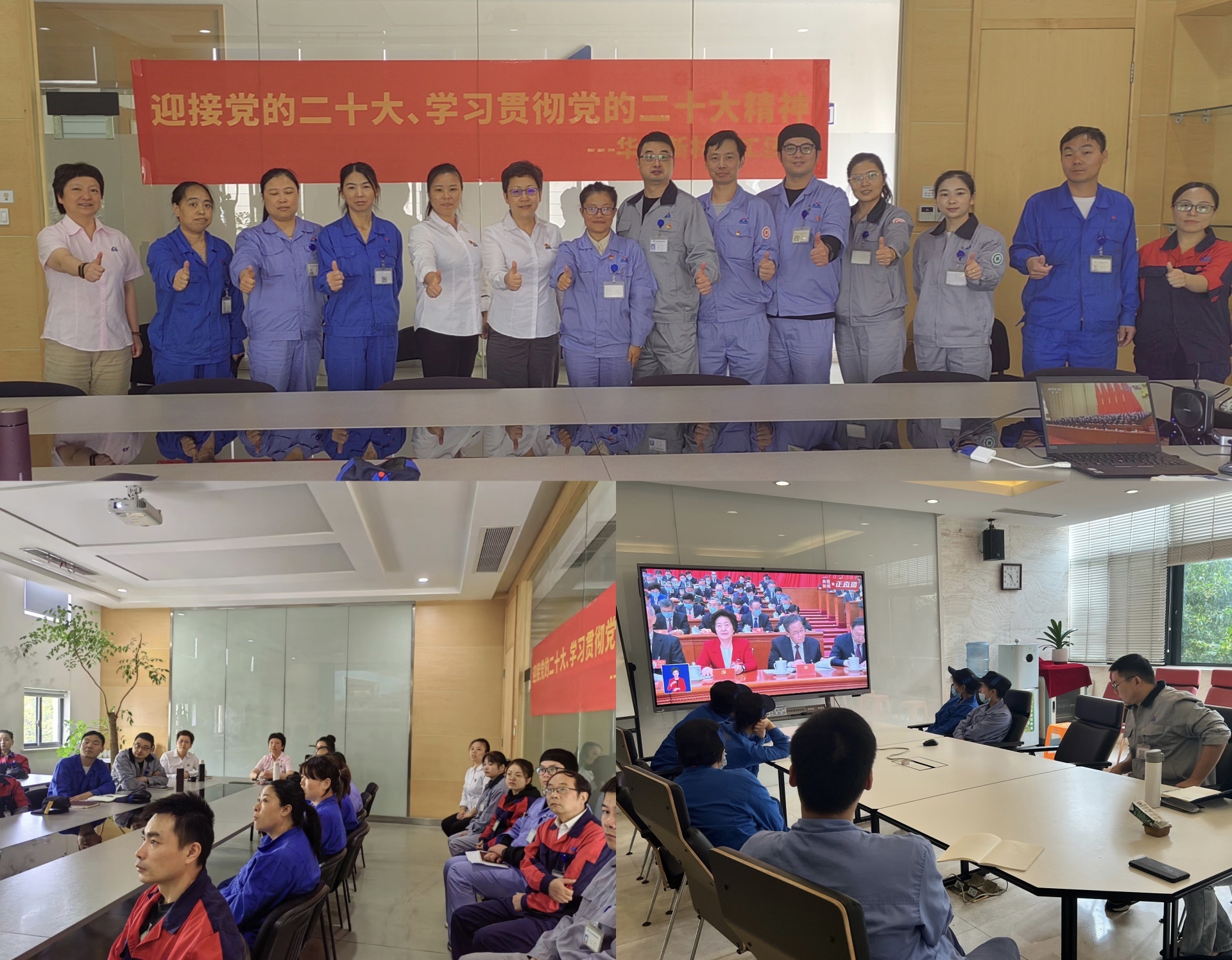
The 20th National Congress of the Communist Party of China was held in Beijing this morning. Huaguang New Materials Party Branch, Trade Union, Youth League Branch, and Women's Federation organized company leading cadres, party members, league members, and employees at all levels to watch and learn from General Secretary Xi Jinping's 20th National Congress Report content. The 20th National Congress of the Communist Party of China is a very important conference held at the critical moment of embarking on the new journey of building a modern socialist country in an all-round way and marching towards the second centenary goal. Under the guidance of the spirit of the 20th National Congress of the Communist Party of China, Huaguang New Materials, as a listed company on the Science and Technology Innovation Board, has further strengthened its determination to lead the company's rapid and steady development with scientific and technological innovation, to contribute to the construction of a manufacturing power. Huaguang New Material Collective Organization to Watch the 20th ------------------------------------------------------------------------ huaguang new material chairman jin li mei: After listening to the report made by General Secretary Xi at the opening ceremony of the 20th CPC Central Committee, the contents of the 15th aspect are very comprehensive, objective and leading, and it also greatly boosts our confidence. In particular, the report once again reiterated the two unswervingly firm the fair confidence of our enterprise development. As one of the listed companies on the board, a technology manufacturing company that has been developing for 27 years has become more determined. I will lead all employees of the company to strengthen cooperation between industry, university, research and application, gather talents, adhere to scientific and technological innovation and high-quality development without fear of various difficulties encountered in development, develop and manufacture more innovative and high-quality products to meet the requirements of industrial connection in various application fields and the needs of healthy development of market economy. Lead employees to create better economic benefits by rolling up their sleeves to achieve common prosperity and better give back to the society. Hu Ling, Secretary of the Board of Directors and Party Branch Secretary: The report of the 20th National Congress of the Communist Party of China is inspiring. The Communist Party of China has led the people of the whole country to achieve great achievements in the new era through hard work, hard work and struggle. The report clarified the mission and tasks of the Communist Party of China in the new era and new journey. In order to build a modern socialist power in an all-round way and promote the great rejuvenation of the Chinese nation, it outlined a clear blueprint and sounded the assembly line for progress. As a scientific and innovative enterprise engaged in welding and industrial connecting materials, Huaguang New Materials will increase technological innovation, give full play to the characteristics of the product "industrial universal adhesive", constantly open up new fields and new races, promote green and low-carbon production and intelligent manufacturing, and strive to achieve high-quality development. hangzhou city a new era of good party member huang liu: This morning, I listened carefully to and watched the report of the opening ceremony of the General Secretary Xi Jinping General Assembly. As a party member, I am deeply proud of myself and combine my current work of safety and environmental protection. I will continue to strengthen my professional ability, constantly enhance the initiative and enthusiasm of learning, and give full play to the vanguard and exemplary role of Party members. Do a good job in the safety production management system of safety first and prevention first, and the ecological environment of carbon reduction, pollution reduction, green and low carbon. Guarding our common blue sky and white clouds, green mountains and green waters! yuhang craftsman luo shougen: Fortunately, he was born in China, and felt proud and excited to see the prosperity of the motherland. The 20th National Congress pointed out that to strengthen the support of talents for modernization, science and technology are the primary productive forces, talents are the first resource, and innovation is the first driving force. As a manufacturing unit of new materials, the company needs more innovative talents and practical talents. As a grass-roots craftsman, but also as the company's welding skills leader, I will set a good example, not afraid of hardship, love to eat hardship, for the company to train more practical skills talents, for the company's overall welding solutions due diligence, follow the pace of development of the times for the enterprise to expand new track development efforts! Money to open the craftsman Bu Yongzhou: By watching General Secretary Xi's work report, I have seen the development of China's aerospace industry, and I am proud to see that my country's various cutting-edge technologies have reached the international leading level. As a company's R & D personnel, I will continue to learn new knowledge, continue to conduct in-depth basic research, consolidate their professional skills, speed up new product development, improve the quality of new product development, and provide a modest force for the development of the company. The great achievements of the new era are the work of the party and the people, and we will continue to strengthen our confidence, work with one heart and one mind, work hard and forge ahead courageously, and work together to build a modern socialist country in an all-round way and promote the great rejuvenation of the Chinese nation in an all-round way! In the future, under the leadership of the Communist Party of China, Huaguang New Materials will strengthen its confidence, face difficulties, think in one place, work hard in one place, twist into a rope, and gather the strength of common struggle.
10-05
→Effect of materials on the reliability of lead-free solder joints
2022-10-05
The choice of solder is extremely important. At present, most of the tin-silver-copper alloy series are used, and the liquid phase temperature is 217 ~ 22l ℃, which requires reflow soldering to have a higher peak temperature. As mentioned above, solder and conductor materials (such as Cu foil) are easy to oxidize at high temperature, and intermetallic compounds grow rapidly. Because in the welding process, when the molten solder is in contact with the welding substrate, a layer of metal intermetallic compound (IMC) is formed at the interface due to high temperature. Its formation is not only controlled by reflow temperature and time, but also its thickness increases with time in the later use process. Studies have shown that intermetallic compounds on the interface are a key factor affecting the reliability of solder joints. The existence of an excessively thick intermetallic compound layer will seriously cause the solder joint to fracture, and the toughness and low-cycle fatigue resistance will decrease, which will cause the reliability of the solder joint to decrease. In addition, since the lead-free solder and the conventional Sn-Pb solder have different compositions, their reaction rates and reaction products with the pad materials, such as Cu, Ni, AgPd, etc., may be different, so that the solder joints may also exhibit different reliability. At the same time, the compatibility of solder and flux will also have a great impact on the reliability of solder joints. Studies have shown that the incompatibility between the components of solder and flux will lead to a decrease in adhesion, in addition, due to the mismatch of thermal expansion coefficients, it will accelerate the periodic fatigue failure of the solder. Therefore, special attention should be paid to the selection of solder and flux with excellent compatibility to withstand the high temperature impact of lead-free reflow soldering. In addition, each solder interconnection component comes from different manufacturers, so the quality of the components is inevitably uneven, such as poor solderability of the device pins, which has a great impact on the reliability of the lead-free solder joints.
09-30
→Analysis of the process performance and influencing factors of electronic solder (below)
2022-09-30
(2) Oxidation resistance of liquid solder That is, at a certain temperature, the ability of liquid solder to resist oxidation reaction. The oxidation of molten solder will not only cause serious waste of metal, but also the oxide film will hinder the combination between the solder and the base metal surface atoms, and will also cause the oxide film to enter the weld to produce various welding defects. According to the theory of liquid metal oxidation, the surface of liquid solder will strongly adsorb oxygen. The adsorbed oxygen molecules will decompose into oxygen atoms at high temperature, and the oxygen atoms will lose electrons and become ions, and then combine with metal ions to form metal oxides. The composition and structure of the oxide film are different, and the growth rate, growth mode and distribution coefficient of the oxide in liquid solder will be very large. This, in turn, is closely related to the composition of the solder. In addition, the oxidation is also related to the temperature, the partial pressure of oxygen in the gas phase, the adsorption and decomposition rate of oxygen on the surface of the solder, the combination ability of surface atoms and oxygen, the density of the surface oxide film, and the dissolution and diffusion ability of the product. (3) Wetting properties of liquid solder That is, at a certain temperature, the liquid solder produces wetting speed and wetting force on the base material. Poor wetting performance will lead to brazing difficulties, prone to false welding, false welding, and desoldering, which directly affect the mechanical and electrical properties of the brazed joints, resulting in poor signal transmission, information distortion, poor sensitivity, and reduced reliability. (4) Diffusivity of liquid solder That is, the ability of liquid solder to flow and expand on the surface of the base metal at a certain temperature. The diffusivity and wettability of liquid solder are closely related, but there are differences. Diffusivity is the comprehensive performance of wettability and fluidity of liquid solder. In the soldering process, for example, the poor diffusion of liquid solder will cause the solder to expand insufficiently in the area to be soldered or create a void in the weld, reducing the bonding area, and also easily causing the solder joint or weld to bridge or pull the tip to cause a short circuit. Clearly, both wetting and oxidation factors have an effect on diffuse flow.
09-27
→Analysis of the process performance and influencing factors of electronic solder (above)
2022-09-27
The process performance of solder refers to its performance during use. According to the investigation, the technical problems encountered in the process of electronic soldering are mainly the behavior of liquid solder. The wetting, flow, filling and spreading of liquid solder on the surface of solid base metal are the premise of brazing. Without this premise, even if the physical, mechanical properties and microstructure of the solder are better, it is futile. In the process from melting to solidification and crystallization, the various properties of the solder are interrelated and influenced. For example, the melting temperature of solder determines the temperature range of brazing, and the difference between the solid and liquidus temperatures of solder determines the speed of melting or solidification. Oxidation of the surface of liquid solder will hinder the combination of interface atoms to achieve the required atomic spacing, thus affecting its wetting, flowing, filling and spreading ability. The capillary action of liquid solder wetting on the base metal will determine the binding ability of solder and base metal, at the same time, it affects the filling ability; the spreading or diffusion of liquid solder on the surface of the base metal affects the filling ability on the one hand, and the separation ability of solder between dense solder joints on the other hand; when there is a certain degree of dissolution and diffusion of atoms in the interface, it is beneficial to wetting and spreading, but too much mutual solubility or diffusion will produce too many intermetallic compounds at the interface, which is detrimental to wetting and spreading; at a certain brazing temperature, the lower the melting point of the solder, the smaller the difference between the solid and liquidus temperatures, the better the wettability and fluidity. Therefore, the solder process performance contains a wide range of content, these properties must be dialectical comprehensive analysis, can not only emphasize a certain performance and ignore the impact on other properties. From the point of view of use, according to the behavior of solder in the brazing process, the process performance and influencing factors of electronic solder are analyzed and summarized as follows: (1) Melting/curing temperature That is, the solidus and liquidus temperatures of the solder alloy and the temperature difference between the two. In the thermal cycle of brazing, in the heating stage, the solidus is the temperature at which the solder starts to melt, and the temperature at which the liquid solder starts to produce interfacial action on the solid base metal, while the liquidus is the melting end temperature; in the cooling stage, the liquidus is the starting temperature at which the solder solidifies, and the solidus is the end temperature at which the liquid solder stops the interfacial reaction. The solder is pasty between the solid and liquidus lines. The smaller the temperature difference between the solid and liquidus lines, the faster the melting or solidification speed, and the more favorable the brazing operation [71. The melting temperature of the solder is determined by the alloy composition. Electronic solders generally use tin-based alloys. When a low-melting-point metal component is added to tin, its melting temperature will decrease, while a high-melting-point metal will generally increase its melting temperature. The closer the composition of the alloy is to the eutectic point, the lower the melting temperature, and the smaller the temperature difference between the solid and liquidus. When the solder composition reaches the eutectic point, the melting temperature is the lowest, and the temperature difference between the solid and liquidus is zero.
09-23
→Basic Requirements for Lead-free Electronic Solder in Electronic Assembly
2022-09-23
Most (but not all) assembly manufacturers require a minimum solid phase temperature of 150°C to meet the operating temperature requirements of electronic equipment, and the maximum liquid phase temperature depends on the specific application. Good conductivity This is the basic requirement for electronic solder connection. Good thermal conductivity In order to dissipate heat energy, electronic solders must have rapid heat transfer capabilities. Smaller solid-liquid coexistence temperature range Non-eutectic alloy will solidify in a certain temperature range between liquid phase temperature and solid phase temperature. Most metallurgical experts recommend that this temperature range be controlled within 10 ℃ in order to form good solder joints and reduce defects. If the alloy solidification temperature range is wide, solder joint cracking may occur, causing premature damage to the equipment. Low-toxicity electronic solders and their components must be non-toxic, so this requirement excludes cadmium, thallium and mercury from consideration; some also require that byproducts extracted from toxic substances cannot be used, thus excluding bismuth, which is mainly derived from byproducts extracted from lead. Have good solderability Under the conditions of existing equipment and no-clean flux, the electronic solder should have sufficient wettability to be able to be used with regular no-clean flux. Because the cost of inert treatment of the wave crest is not too high, it can accept the requirements of wave soldering and inert environment, but in the case of SMT reflow, the alloy is best to have the ability to reflow under air, because the cost of inert treatment of the reflow furnace is higher. Good physical properties (strength, elongation, fatigue, etc.) The electronic solder must be able to provide the mechanical strength and reliability of 63Sn/37Pb, and will not have protruding fillet welds on the through hole device (especially for alloys with large solid-liquid coexistence temperature range). Production repeatability/melting point consistency. The electronic assembly process is a high-volume manufacturing process that requires a high level of repeatability and consistency. If the composition of some electronic solders cannot be repeatedly manufactured under high-volume conditions, or If its melting point changes greatly due to composition changes during mass production, it cannot be considered. Electronic solders composed of more than three components tend to be separated or changed in composition, so that the melting point cannot be kept stable. The higher the complexity of the alloy, the greater the possibility of its change.
09-20
→Basic Requirements for Lead-free Electronic Solder in Electronic Assembly (Part I)
2022-09-20
The basic processes of lead-free soldering assembly include: a. lead-free PCB manufacturing process; B. 96.5Sn/3.5Ag and 95.5Sn/4.0Ag/0.5Cu eutectic and approximate eutectic alloy systems applied in solder paste; C. 99.3Sn/0.7Cu eutectic alloy system for wave soldering applications; D. 99.3Sn/0.7Cu alloy system for manual soldering. Although these are all feasible processes, there are still several major problems in the specific implementation, such as the raw material cost of electronic solder is still higher than that of standard Sn/Pb process, the restriction on wettability is increased, the inert air state (sufficient nitrogen is required) is required in wave soldering process, and the thermal requirements for various components are increased due to the possibility of raising the reflow temperature to the limit temperature range (between 235 ℃ and 245 ℃). As far as lead-free alternatives to electronic solders are concerned, there is no generally accepted set of specifications. After many discussions with many professionals in this field, we have come to the following technical and application requirements: Many assembly manufacturers require that the price of lead-free alloys cannot be higher than 63Sn/37Pb, but unfortunately all existing lead-free alternatives cost at least 35% more than 63Sn/37Pb. In the choice of lead-free solder and solder wire, the cost of metal is one of the most important factors, and in the production of solder paste, because the technical cost of the overall manufacturing cost is relatively high, so the price of metal is not so sensitive.
09-18
→How to prevent the causes and hazards of welding flash during operation?
2022-09-18
The liquid metal in the weld flows to the base metal that is not melted under heating or overflows from the root of the weld, and the metal nodules formed after cooling that are not fused with the base metal are the weld nodules. Too strong welding specification, too fast welding rod melting, poor quality of welding rod (such as eccentric core), unstable welding power supply characteristics and improper operation posture are all easy to bring welding flash. In the horizontal, vertical, vertical position is more likely to form a weld bead. The weld flare is often accompanied by incomplete fusion and slag inclusion defects, which can easily lead to cracks. At the same time, the weld bead changes the actual size of the weld, which will bring stress concentration. The internal weld of the pipe reduces its internal diameter and may cause blockage of the flow. Measures to prevent weld flare: make the weld in the flat welding position, correctly select the specification, select the non-biased core electrode, and operate reasonably.

Telephone:+86-18594983359
E-mail:Firmkim@cn-huaguang.com
Zip Code: 311112
Address: No. 82, Qihang Road, Renhe Street, Yuhang District, Hangzhou City, Zhejiang Province

Douyin QR code

We chat number

WeChat public account